Chevy Volt 120v Charger Manual
Current Chevy Volt owners will be notified of the portable charger swap out over the next few weeks, said GM, and will receive the beefier unit when the vehicles are brought in for the previously.
2012 Chevy Volt Charger
Q: Why purchase a ClipperCreek Level 2 Charging Station (EVSE)? A: ClipperCreek® 240V EV charging stations or EVSEs are the gold standard in the industry. Our products surpass all others in not only durability and longevity, but in overall value. With our fully sealed NEMA 4 enclosures you can rest assured that all the components inside your station are protected. ClipperCreek® also offers a no strings attached 3 year warranty for our HCS, LCS, PCS, ACS, and ECS series products. At ClipperCreek® we proudly manufacture our products in Auburn, CA USA and with our highly competitive pricing you can be certain you are receiving the best value possible. Q: Is there a standard connector for all plug-in vehicles?
A: Yes, the industry standard connector in North America is the SAE J1772™ connector and all of ClipperCreek’s EVSEs come standard with this type of connector. The SAE J1772™ standard also covers the communication protocol used by the vehicle and charging station. The SAE J1772™ standard connector is used for Level 1 (120V) and Level 2 (240V) charging. One caveat is that one Automaker, Tesla™, uses its own proprietary connection interface. The Tesla™ vehicles still utilize the SAE J1772™ communications protocol, so Tesla™ vehicle owners can utilize standard SAE J1772™ charging stations by utilizing a Tesla™ provided connector adapter.
Q: What different 240V plug types are available with your stations? Q: Will using a station with higher output current rating than my vehicle can accept damage my vehicle? A: No, using a higher amperage station will pose no harm to the vehicle.
ClipperCreek® charging stations are a pass through, electrical safety appliance. The EV is in complete control of the charge and will only take in what power it can accept and no more.The actual charging takes place on the vehicle. Our units will supply AC power to the vehicle and the vehicles onboard charger will convert the AC power to DC power and charge the vehicle’s batteries.
EX: Chevy Volt can take in 3.3kW for charging and the can deliver up to 7.7kW. When an is plugged into the Volt the station will “tell” the Volt how much power is available through the stations pilot communication signal. From that point the vehicle will take over, activate the station and take whatever power it wants, up to the limit established by the station.
Some of our customers purchase 240V charging stations that can offer a higher power level than their current vehicle can accept to future proof their installation. Q: If I install an indoor rated ClipperCreek 240V charging station can I charge my vehicle outdoors?
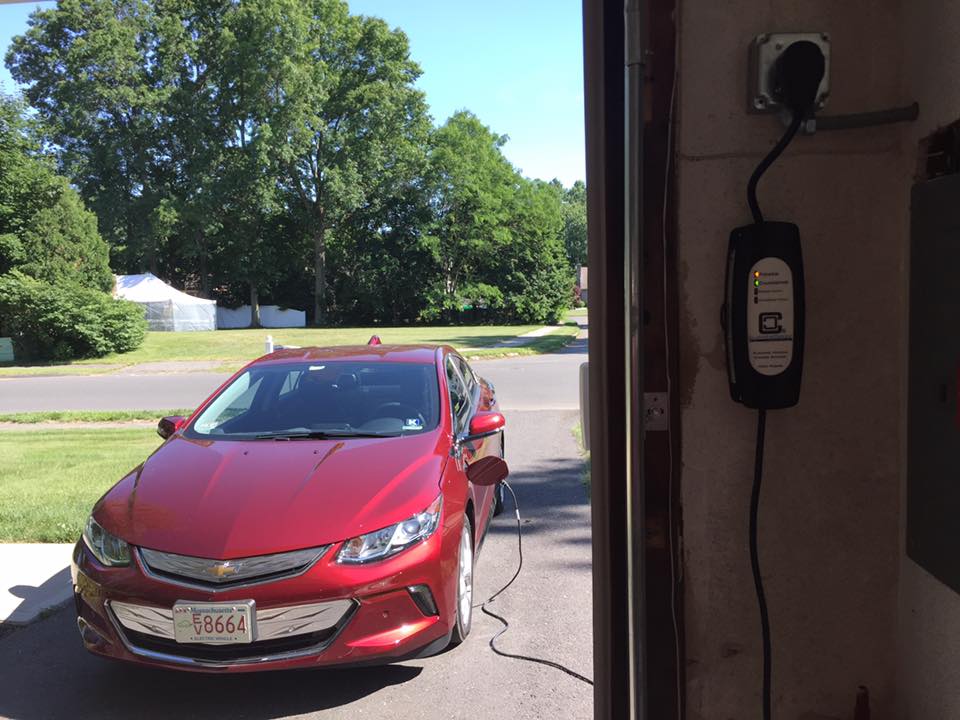
A: Yes, many customers have room to install their 240V EV charging station in their garage, but do not have room for the vehicle itself. Customers will install the station inside their garage and run the charging cable outside to charge the vehicle. If you plan to utilize the station in this fashion we do recommend not closing the garage door all the way down on the charging cable, but leave a small gap to ensure the longevity of the cable.
Also, a can be installed outdoors to provide a place to store the connector head when not in use with the vehicle. The holster provides a secure place to store the connector head and provides extra protection from the elements. Watch our video, for additional information. Q: How much energy does the ClipperCreek charging station draw when it is powered, but not charging my vehicle? A: ClipperCreek® products have very minimal standby power consumption; the standby power draw on the HCS and LCS charging stations is approximately 2 watts. For comparison, leaving an powered up for about 2 months (50 days) would use the same amount of power as leaving a 100 watt light bulb on for 24 hours (a very small amount). ClipperCreek® provides the stations without a power switch because the stations standby power consumption is so low and a switch can be forgotten (accidentally not turned on).
Some customers will add a timer or standard in-line switch on their own to turn power off to the station to avoid the power draw, as this is not an issue for the station, but as stated before the power consumption is very minimal. Q: How can I find places to charge in public? A: You can visit websites such as or which allow you to search by address, city, or zip code to find stations in your area. The websites are also available as apps that you can download to your smart phone for a convenient way to search for stations when away from your computer. Is a peer-to-peer network for electric vehicle (EV) charging where home charging station owners rent their stations to other EV drivers.
Any EV driver can reserve and pay for use of an EVmatch charging station in advance to know exactly when and where they'll charge next. EVmatch stations include Level 1 (110V) and Level 2 (240V) charging stations, and have options for all vehicle types including Tesla.
EVmatch operates across Southern California and is quickly expanding across the West Coast of the United States. Q: What length charging cable should I get? A: As long as possible!
(25 feet is the max length allowed by the National Electric Code. ClipperCreek® offers a 25 foot charging cable on our products as a standard option, there is no premium charged for having the 25 foot cable. 25 feet is the longest output cable length that can be provided on an EV charging station based on National Electric Code (section 625) requirements.
Getting the longest cord length possible can save on installation expense by allowing the station to be installed closer to the service panel. Getting the longest cord length possible also gives users added operational flexibility for the station. Watch our fun video for more information about the length of cable you should look for when purchasing an EV charging station. Q: What is a charging station (EVSE), and why is it required? A: The technical name for these products is EVSE (Electric Vehicle Supply Equipment), commonly called a charging station or charging dock. These charging stations are built into the EV charging standard for electrical safety; first for the user, then the vehicle and then the power grid.
The charging stations primary function is as electrical safety equipment. A standard home charging station, whether it is a or a, will provide pass through AC power to the vehicle for charging. The vehicle will convert this AC power to DC power and utilize that to recharge the batteries, the actual charger is on-board the vehicle. A charging station implements several layers of redundant safety features to protect the user from potential electrical hazards while connecting and disconnecting the station to the vehicle for charging.
Once connected to the vehicle the station will inform the vehicle that power is available and at what level. From that point the vehicle takes over, initiates and takes full control of the power transfer, unless an electrical fault occurs, in which case the station will stop the power transfer immediately. Q: How do I determine which charging station (EVSE) will provide the fastest charge for my vehicle? A: This will depend on what EV is being charged. Different vehicles have different battery pack sizes, the battery pack size will determine the amount of energy stored in the vehicle. The next piece is the power going into the vehicle; different vehicles have different power acceptance rates.
Chevy Volt 120v Charger Manual Transmission
Charging stations are also available with various max power delivery ratings. If the charging station offers less power than what the vehicles maximum acceptance rate, the charging station would be the limiting factor in determining the charge time. If the vehicles acceptance rate is lower than the charging stations maximum output rate then the vehicle will be the limiting factor. To determine your estimated total charge time you would take you vehicle battery pack rating and divide it by whichever number is lower, the vehicles acceptance rate, or the stations output rate. For a list of vehicle charge battery pack sizes and charge times you can check visit our blog at:. Note: Most vehicles will provide this information through the dashboard interface once you plug into a charging station.
Q: What is the difference between a hardwired installation and a plug-in installation? A: Some of the ClipperCreek® charging stations are offered for hardwired installation and others for plug-in installation. The hardwired stations will have three feet of flexible conduit coming from the top or bottom (depending on the model) of the station with the service wires sticking out of the conduit an additional six inches or so for easy installation into a junction box.
With a hardwired station the installation is more permanent, the station can still be moved, but you would need an electrician to come out to uninstall the station and then reinstall the station at your new location. ClipperCreek® hardwired stations are rated for indoor or outdoor installation.
With a ClipperCreek® plug-in unit the station will have a high quality over molded 240V plug attached instead of the flexible conduit. The plug length is 12 inches, the longest length allowed per National Electric Code, and this includes the plug itself in the measurement. There is no standard 240V plug, which is why ClipperCreek® offers different types of 240V plugs with our charging stations. For a plug-in installation the electrician would install the matching 240V receptacle to fit the plug type that was ordered with the station. Once the receptacle is installed, simply mount the station to the wall and plug-in. Some customers already have a 240V receptacle installed in their home and will order the unit with the corresponding plug. This will make the installation cost virtually $0 as you would only have to mount the station and plug-in.
If you have a 240V plug, but are unsure if ClipperCreek® carries the matching plug type, please call us at or email us. Our customer service representatives can help determine what type of receptacle you have and what products would be appropriate. ClipperCreek® made a short video to help you decide whether a hardwired or plug in station is most practical for you. Q: Does ClipperCreek offer an EVSE that can plug into a NEMA 10-30 receptacle? ClipperCreek® does not manufacture any stations with the NEMA 10-30 plug as the corresponding receptacle (outlet) for this plug type is typically wired with a neutral wire as opposed to an earth ground and all of our models require an earth ground connection in order to operate properly. Additionally, when charging a vehicle the ground is passed through to the vehicle from the station for safety earth grounding during charging.
Chevy Volt Charger Repair
If a neutral is used instead of a ground the neutral could generate a charge on the vehicle chassis, creating a potential safety hazard upon contact with the vehicle during or after charging. For these safety reasons we do not offer an EVSE with the NEMA 10-30 plug and it would not be advised to utilize any of our EVSEs with a NEMA 10-30 adapter. If you have a NEMA 10-30 receptacle you would like to use for a ClipperCreek® EVSE it would be recommended to have an electrician re-purpose the NEMA 10-30 receptacle into a NEMA 14-30 or a NEMA L6-30 receptacle. Q: What’s the difference between UL and ETL listing? A: and are both what is called Nationally Recognized Testing Laboratories (NRTL). NRTL’s are in place to provide independent safety and quality certifications on products, for electrical appliances their certification is typically required (especially 240V appliances). UL develops the testing standards and tests to them, ETL tests to UL standards.
In order for an inspector to sign off on permitted installation for an EVSE the requires that the EVSE be NRTL listed (in the US that is ETL or UL). ClipperCreek® does use both laboratories; the selection of which laboratory depends on which company provides the best value for their service that we can then in turn pass on to our customers.
Learn more about safety certification in our video. Q: Can I install a ClipperCreek 240V charging outdoors? A: For outdoor installations we recommend installing a hardwired 240V EV charging station. All ClipperCreek charging stations have a fully sealed NEMA 4 enclosure that provides superior protection to the components inside the station from outdoor elements. The NEMA 4 enclosure ensures the components inside the unit are protected from the elements. We recommend a hardwired unit for an outdoor installation as it provides better weather protection for the connection to power.
If you install the plug-in unit outdoors we would recommend installing a watertight cover over the plug and outlet combination. We also recommend checking with a licensed electrician to ensure installing a 240V plug-in charging station outdoors meets your local codes. There was a change in the National Electric Code requirements at the beginning of 2017 that allowed plug-in 240V charging stations to be installed outdoors, however sometimes local codes can vary.
Also, an optional wall mount can in installed indoors or outdoors. The optional holster provides a secure place to store the connector head and provides extra protection from the elements. Watch our short video for more information.